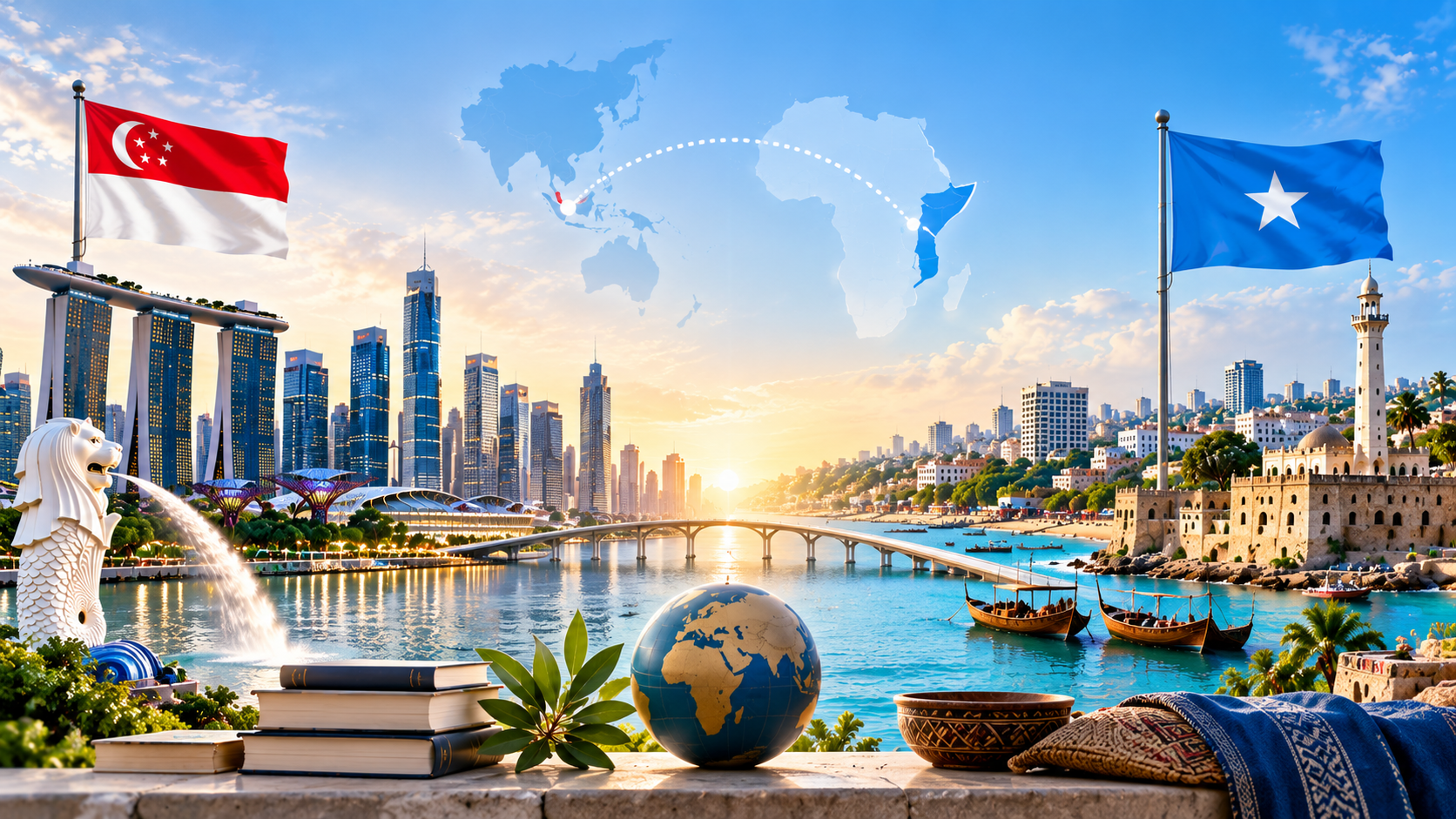
What Somalia Can Learn from Singapore
This personal reflection explores lessons Somalia can draw from Singapore’s experience of leadership, institutional development, public-sector transformation and national planning.
Full Commentary
Drawing on the August 2026 NLA/OPM Executive Leadership Study Tour to Singapore, the reflection considers how Singapore’s emphasis on discipline, human capital, digital transformation, merit, lifelong learning, infrastructure and institutional capacity can inform Somalia’s development journey. It argues that Somalia should not attempt to replicate Singapore’s institutions or circumstances, but should adapt relevant principles to its own political, social, economic and demographic realities. Attention is given to strengthening leadership development, professional public administration, youth investment, trade and logistics, green urban development, digital governance/gov-tech and diaspora engagement. The central message is that sustainable national transformation depends on turning ambition into capable institutions, effective systems and a culture of collective responsibility.
Keywords: Singapore; Somalia; Leadership Development; Institutional Capacity; Public-Sector Reform; Human Capital; Digital Transformation
A Personal Reflection from the NLA/OPM Executive Leadership Study Tour
There are journeys that take you to a place, and there are journeys that change the way you see your own country. My recent visit to Singapore with colleagues from the National Leadership Academy (NLA) of Somalia and Office of the Prime Minister, as part of an Executive Leadership Study Tour to the Lee Kuan Yew School of Public Policy at the National University of Singapore, was very much the latter.
Singapore was not simply impressive because of its skyscrapers, clean streets, efficient transport or spectacular architecture. What struck me most was the system behind the spectacle. Everywhere we went, from Changi Airport to the National University of Singapore, from Gardens by the Bay to the public transport network, from the historical quarters to the shopping districts, there appeared to be an underlying culture of planning, discipline, service excellence, accountability and continuous improvement.
For the NLA delegation, the visit was particularly meaningful because our institutional mandate is itself centred on leadership development, public-sector capacity building, governance and the creation of a new generation of principled and capable Somali leaders. The study tour therefore became more than an academic visit. It became an opportunity to ask a difficult but necessary question:
What can Somalia realistically learn from Singapore not by copying Singapore, but by understanding the principles that enabled Singapore to transform itself?
The answer is not that Somalia should become Singapore. Somalia has its own history, geography, culture, institutions and realities. The lesson is that development is ultimately a product of choices, institutions, leadership, discipline and collective commitment.
From Mogadishu to Singapore: The First Lesson Was at the Airport
Our journey itself provided an interesting introduction to the contrast between different systems. Travelling from Somalia through Addis Ababa and onward to Singapore, we experienced a highly coordinated international travel system. Prior to arrival, travellers are required to complete the SG Arrival Card electronically within three days before arrival, an example of how digital systems can simplify and organise government processes before a citizen or visitor even reaches a physical government counter. (ICA)
Upon arrival at Changi Airport, the experience was striking. Immigration processing relied heavily on digital technologies and automated clearance, creating an impression that government had been deliberately designed around efficiency and the user experience.
For a Somali visitor, this creates an important reflection especially after several immigration stamping checks from the port of exit, Aden Adde International Airport. We often speak about digital transformation as if it means purchasing computers, developing websites or introducing software. Singapore demonstrates that digital transformation is fundamentally about redesigning processes. The question Somalia should therefore ask is not merely, “What technology can we buy?” but rather: “How can we redesign government services so that citizens experience government as simple, predictable, transparent and efficient?”, that is a leadership question before it is a technological question.
Singapore Is Small in Geography but Large in Ambition
Singapore's physical circumstances make its transformation even more remarkable. The country's land area is approximately 744.3 square kilometres, according to Singapore's official statistics. (SingStat) Yet within that limited physical space, Singapore has developed a globally connected economy, sophisticated infrastructure, strong institutions, advanced education systems and a highly organised urban environment. Its population stood at 6.11 million in June 2025 comprising of 3.66 million citizens, 0.54 million permanent residents and 1.91 million non-residents. (Population Singapore) The lesson here is not about geographical size. It is about how a country converts constraints into incentives for innovation, with its limited space Singapore had to plan its land carefully, lacking natural resources but rather heavily investing in human capital thus aiding them to compete internationally using sporadically magnificent measures in place that built connectivity, infrastructure and institutions capable of attracting investment and talent. For Somalia, the lesson is equally powerful as it possesses assets Singapore did not have in abundance: a long coastline, agricultural potential, livestock, fisheries, a young population, strategic proximity to the Gulf, the Red Sea and the Indian Ocean and a globally dispersed diaspora. The question is therefore not whether Somalia has potential, but can it develop the institutions and leadership discipline necessary to convert potential into national prosperity.
The Lee Kuan Yew School of Public Policy: Leadership as an Institution
Our central purpose in Singapore was the Executive Leadership Study Tour at the Lee Kuan Yew School of Public Policy and engagements across the National University of Singapore ecosystem. The programme exposed the NLA/OPM team to approaches on executive education, public-sector leadership, lifelong learning, digital education and institutional development. We also engaged with institutions including the Institute for Adult Learning (IAL), NUS Institute of Systems Science/Digital Academy, and NUS School of Continuing and Lifelong Education (SCALE) at Kent Ridge, while experiencing the broader University Town campus and lifelong-learning environment.
A formidable lesson from the Singapore experience is that leadership development cannot be reduced to occasional workshops, because its sine qua non to have an institutional ecosystem that connects executive education, public-sector training, evidence and research, policy analysis, digital learning, professional development, case-based learning, continuous learning and sustained engagement with government and society. This has direct relevance for the National Leadership Academy (NLA), which has an opportunity to evolve beyond being merely a leadership training centre into a national platform for leadership knowledge, executive education, public-sector transformation, research and policy dialogue. Such an institution would develop leaders not only through theoretical instruction but by engaging them with real governance challenges, generating evidence, translating research into policy and creating continuous opportunities for professional learning and reflection. As McDougal, Lasswell and Reisman (1973) aptly observed, “Intelligence is a critical function at all levels of decision making, yet its very ubiquity seems to have obscured it from visibility to scholarly inquiry.” This insight reinforces the need for NLA to position leadership intelligence, evidence-informed decision-making and policy learning at the heart of Somalia’s public-sector leadership and institutional transformation agenda.
From Meritocracy to Competence: The Leadership Question
Singapore's experience also raises an important conversation around meritocracy. Having previously engaged with publications examining Singapore's evolving meritocracy, I arrived with an academic interest in the subject but left with a more practical reflection, institutions perform better when competence, responsibility and performance matter. This doesn’t mean that Somalia should mechanically reproduce Singapore's model for our social and political context is fundamentally different, but the underlying principle deserves attention. A functioning state needs systems that identify capable people, develop them, place them where they can contribute, evaluate their performance and continuously build their competencies. For Somalia, this means that there is need to strengthen merit, professional development, performance management and institutional accountability to transform the vital aspect of leadership leveraging the world's youngest populations as the country's demographic reality means leadership development can never be postponed. The challenge isn’t simply to find young people jobs but rather prepare young Somalis to become competent administrators, entrepreneurs, researchers, diplomats, engineers, policy specialists, educators and public leaders. That is precisely where institutions such as NLA can play a transformative role.
A Young Somalia and an Ageing Singapore: Two Very Different Demographic Challenges
One of the most striking contrasts between Somalia and Singapore is demographics as the latter’s total fertility rate was 0.97 in 2024, while its total population was 6.11 million in June 2025. (Population Singapore) contrastingly, Somalia has a very young population and a substantially higher fertility rate hence two different national challenges for two different countries world apart. Singapore is asking: How do we encourage families to have children and ensure that future generations are adequately supported? On our arrival date to Singapore, Sunday, 23 August 2026 there was National Day Rally, where Prime Minister Lawrence Wong announced expanded support for families, with children expected to receive almost S$70,000 in direct financial support as they grow up, alongside childcare, education and other family-support measures. (Prime Minister's Office Singapore)
Somalia faces almost the opposite challenge: How do we convert a very large youth population into an economic and demographic dividend? This is where Somalia's greatest opportunity may lie. A young population without education, skills and employment can become a source of frustration but a young population equipped with skills, entrepreneurship, technology and ethical leadership can become the country's greatest national asset. The Key takeaway lesson herein isn’t to copy Singapore’s population policy but rather to recognise the importance of anticipating demographic realities and building institutions around them. For Somalia, that means investing now in the human capital of its young population.
The Singapore Civil Service: Government as One System
Another powerful lesson concerns public-sector coordination. Singapore's approach demonstrates the value of viewing government as an interconnected system rather than a collection of isolated ministries. For Somalia, one area worth exploring is a structured civil-service rotational and secondment programme since a carefully designed system could allow selected civil servants to undertake temporary assignments across federal ministries, Federal Member States and public institutions. Such exposure could help officials understand different sectors, strengthen coordination and build a generation of public servants capable of seeing government from a whole-of-government perspective (WOG). The objective wouldn’t be to copy Singapore's system wholesale rather Somalia could adapt the principle of cross-government learning and professional mobility to its own federal context. A pilot could begin with senior and mid-level civil servants with clear rules around grade, tenure, benefits, professional development and performance such an approach could help reduce institutional silos and strengthen the culture of government as a shared national enterprise.
Trade: Somalia Should Look at Its Coast Differently
Perhaps one of the most consequential lessons from Singapore concerns economic geography for it didn’t simply become successful because it manufactured goods. Its transformation involved the deliberate development of a high-value, trade-oriented economy built around connectivity, logistics, human capital and services. For Somalia, this is particularly relevant with a strategic coastline sitting close to some of the world's most important maritime and commercial routes as geography alone doesn’t generate prosperity but rather Infrastructure, customs systems, security, skills, ports, financial services, logistics and predictable regulation are what turn geography into economic value. Somalia therefore has an opportunity to develop what might be described as a: “Singapore model adapted to the Somali coast.” This could mean: a multifaceted approach with efficient ports, reliable customs, digital trade systems, skilled young people, logistics, private investment and regional connectivity thus making Mogadishu, Kismayo and other Somali ports superior revenue generating beacons that mould gateways connecting East Africa, the Gulf and Asia hence making Somalia a regional economic giant. With reference to Singapore’s entrepôt trading system, Somalia has a potential to become a place where goods are transported, stored, processed, packaged, financed and re-exported. This requires patient institution-building, but the economic opportunity is enormous.
From Gardens to Green Cities: When Green Development Becomes National Identity
Our visit to Gardens by the Bay, Singapore Botanic Gardens, Sentosa Island and the entire smart green city demonstrated how Singapore has transformed green spaces, public institutions, tourism and urban planning into components of national development and identity. Somalia has the foundations of a similar opportunity in places such as Peace Garden, Darusalam Garden and Jazeera Aqua Park among others in Mogadishu for instance but bringing these spaces to Singapore’s level would require substantial investment in planning, maintenance, landscaping, water management, accessibility and public-private partnerships. The lesson, however, is not to reproduce Singapore physically but to borrow its philosophy of turning public spaces into assets for education, tourism, recreation, environmental resilience and economic development. Somalia could gradually transform its gardens, parks, beaches and coastal spaces into well-planned green and recreational destinations while integrating trees, water conservation, renewable energy, waste management and climate-resilient design into urban development. In this sense, Singapore offers Somalia a powerful reminder that a garden is not merely a garden it can become an investment in the environment, the economy, public wellbeing and national identity.
Cleanliness, Discipline and the Social Contract
Perhaps one of the most memorable aspects of Singapore wasn’t its under-ground malls or technology but the behaviour of all and sundry in that city wasn’t something that goes without saying, clean streets, orderly public spaces, disciplined traffic, organised queues, respect for designated areas and a general sense that public spaces belong to everyone created a powerful social environment. During the visit, I was particularly struck by Singapore's approach to smoking and vaping. Smoking is prohibited in numerous public places, while designated smoking areas are provided in permitted locations. (National Environment Agency). Singapore also maintains strict controls on vaping; possession and use of vaporisers are prohibited under its current regulatory framework. (gov.sg) Chewing gum is also among goods prohibited for import, subject to specified exceptions. (Singapore Customs) The lesson is not that Somalia should copy every Singaporean restriction but how can our people come together and commit to this kind of social contract. Rules work when citizens understand that individual behaviour affects the collective environment and when institutions consistently enforce reasonable rules. Development therefore requires both strong institutions and responsible citizens since one sustainably can’t exist without the other in line with the nature of the Triple Bottom Line.
Transport: Mobility as an Economic System
Singapore's transport network offered another lesson in integrated planning with the experience of travelling around the city through buses, cable cars, trains, underground connections and integrated commercial spaces demonstrating that transport isn’t merely about moving people from one location to another. It’s about the way it connects people to education, employment, commerce, housing and recreation. Singapore's Land Transport Authority describes integrated transport hubs where bus interchanges connect directly with MRT stations and adjoining developments such as shopping centres. (Land Transport Authority) Conversely for Somalia, transport infrastructure should similarly be viewed as part of economic development because a reliable public transport can connect young people to universities, workers to employment, businesses to markets and communities to essential services. The result is to Build an integrated mobility system that supports economic and social opportunity.
The Other Singapore: Heritage, Identity and Cultural Confidence
Singapore is sometimes presented exclusively as a modern city of glass towers and technology contrastingly we saw a distinct city walking through The Arab Street, Sultan Mosque, Little India and the Malay Heritage Centre demonstrated that modernization does not necessarily require the disappearance of history. The coexistence of modern commercial districts with religious, cultural and historical spaces provides an important undertaking for Somalia to curb chances of cultural amnesia with an efficient utilization of the extraordinary cultural and historical inheritance from Islamic scholarship and architecture to coastal trading history, oral traditions, poetry and diverse local cultures, the country can build modern cities while preserving and celebrating its identity. It’s important to note that cultural preservation is surely an economic and diplomatic asset through heritage tourism, museums, cultural institutions, research and creative industries.
What Somalia Should Borrow and What It Should Not
The central lesson Somalia can draw from Singapore is not to reproduce its institutions wholesale, but to understand the principles behind them and adapt them to Somalia's own political, economic and social realities. Singapore's experience shows the value of long-term planning, competent public administration, investment in human capital, digital government, integrated infrastructure, trade and logistics, environmental planning and life-long education. At the same time, the Lee Kuan Yew School of Public Policy's work on Singapore's Evolving Meritocracy demonstrates that even successful systems must continually reassess themselves, particularly when meritocracy risks becoming associated with privilege or narrow definitions of academic success. For Somalia, the lesson is therefore to build institutions that reward competence, integrity, skills and performance while ensuring that opportunities are accessible beyond established networks. (Singapore's Evolving Meritrocracy)
Somalia should also learn from Singapore's ability to respond pragmatically to economic shocks. The LKYSPP case study on Singapore's Approach to Managing Economic Crises shows that Singapore responded to crises through coordinated fiscal, monetary and institutional measures designed to protect employment, reduce pressure on businesses and stimulate recovery. The important lesson for Somalia is not to replicate Singapore's specific financial instruments, which depend on a very different fiscal and institutional environment, but to develop its own crisis-management capacity: credible public institutions, reliable economic data, contingency planning, social protection mechanisms and the ability to coordinate government and private-sector responses when shocks occur. (Singapore's Approach to Managing Economic Crises)
The issue of migration provides another important lesson. Singapore has used migration as part of its economic strategy, but its experience also demonstrates the difficult balance between economic needs, national interests and the rights of migrants. The LKYSPP's Ethics of Migration highlights the competing interests of governments, citizens, employers, migrant workers and countries of origin. For Somalia, this is particularly relevant because the country has both a large diaspora and significant outward migration. Somalia can therefore move beyond viewing migration primarily as a problem and develop a national migration and diaspora strategy that connects Somali professionals abroad with investment, skills transfer, research, entrepreneurship and public-sector development, while also strengthening protections and opportunities for Somalis who migrate. (The Ethics of Migration)
What This Means for the National Leadership Academy
For the National Leadership Academy (NLA), the Singapore experience has surely become more of an institutional learning agenda rather than a study tour. As we aim to gradually strengthen executive education and leadership programmes that are public-sector centric with focus on strategic management, digital governance, policy analysis, institutional performance and lifelong learning while utilizing comparative cases such as Singapore to ask a more important question: what can realistically work in Somalia? This approach is consistent with the broader direction of the Lee Kuan Yew School of Public Policy where policy education connects research, professional learning and real-world governance challenges. NLA's Research and Innovation Centre looks forward to turn international experiences into locally grounded research on peace ,security, migration, climate resilience and public-sector transformation. (Lee Kuan Yew School of Public Policy)
The National Leadership Academy also hopes to serve as a bridge between Somalia and its global knowledge networks. Somalia's diaspora contains professionals working across government, academia, technology, finance, medicine, engineering, diplomacy, business and international development. Rather than treating this expertise as an informal resource, NLA has created structured mechanisms for mentorship, visiting expertise, executive education, policy dialogue and knowledge transfer. Singapore's experience suggests that national development depends not only on possessing talented people but on creating institutions capable of organising that talent around national priorities. For Somalia, this could become one of NLA's most practical contributions to institution-building.
The Hardest Lesson: Singapore Did Not Become Singapore Overnight
Perhaps the most important lesson is that Singapore's transformation was not the product of one leader, one policy or one institution. It emerged through decades of institution-building, policy continuity, human-capital investment, infrastructure development and adaptation. Even Singapore's own experience shows that successful systems must evolve; the LKYSPP's discussion of meritocracy, for example, recognises that a system initially built around ability and performance can face new questions about inequality, privilege and how merit should be defined. (Singapore's Evolving Meritrocracy) Somalia should therefore avoid the attractive but misleading question, “How can one leader make Somalia like Singapore?” The more useful question is how Somalia can build institutions and a social compact capable of sustaining reform across governments, political cycles and generations.
From Singapore to Somalia: The Journey Home
Our five-day experience in Singapore therefore leaves us with questions rather than simple answers: How can NLA strengthen executive education? How can Somalia develop a more professional civil service? How can its ports become engines of trade? How can its young population become an economic dividend? How can climate resilience become part of urban planning? How can digital government become a functioning reality? And how can institutions become stronger than individual personalities? These questions extend beyond NLA, but the Academy will surely provide a national platform where public servants, researchers, academics, private-sector actors and diaspora professionals examine international experience and translate relevant lessons into Somali policy and practice.
Conclusion: Singapore as Inspiration, Somalia as the Mission
In a nutshell, my strongest reflection from Singapore is that the country's greatest achievement is not its skyline, gardens, transport system or architecture, impressive as all of these are. It is the system behind them: planning, institutional capacity, public administration, human-capital development, continuous adaptation and collective responsibility. Singapore's response to economic crises demonstrates the value of institutional preparedness; its evolving meritocracy demonstrates that even successful systems must continually examine themselves; and its migration experience illustrates the importance of balancing economic objectives with social and ethical considerations.
Somalia therefore does not need to become Singapore. It needs to become the best version of Somalia. Its young population, strategic coastline, natural resources, entrepreneurial culture, diaspora and human capital provide significant foundations, but these assets must be converted into functioning institutions and productive systems. The real lesson is therefore simple: Somalia should not copy Singapore's destination; it should learn from the discipline of Singapore's journey. If Somalia can build institutions that value competence, invest in its young people, embrace technology, strengthen public administration, develop its infrastructure, harness its diaspora and promote accountability, then it can create its own model of prosperity a peaceful, capable and globally connected Somalia rather than a Somali version of Singapore. The ultimate lesson for NLA is that ambition becomes transformative only when it is converted into institutions, institutions into systems and systems into a culture shared by society.
References:
- The National Population and Talent Division (NPTD) of Singapore: https://www.population.gov.sg/who-we-are/
- The Office of the Prime Minister Singapore: National Day Rally, https://www.pmo.gov.sg/newsroom/ndr2026/
- Dodgson, J., & Auyong, H. (2018). The Ethics of Migration. Lee Kuan Yew School of Public Policy, National University of Singapore.
The Ethics of Migration LKYSPP - Lee Kuan Yew School of Public Policy. (2018). Singapore's Approach to Managing Economic Crises. National University of Singapore.
Singapore's Approach to Managing Economic Crises LKYSPP PDF - Lee Kuan Yew School of Public Policy. (2020). Singapore's Evolving Meritocracy. National University of Singapore.
Singapore's Evolving Meritocracy LKYSPP PDF - Immigration & Checkpoints Authority. (2026). SG Arrival Card (SGAC) with Electronic Health Declaration. Government of Singapore.
SG Arrival Card Immigration & Checkpoints Authority - Immigration & Checkpoints Authority. (2026). Entering Singapore. Government of Singapore.
Entering Singapore Immigration & Checkpoints Authority - Myers S. McDougal, Harold D. Lasswell, W. Michael Reisman, “ The Intelligence Function and World Public Order,” Temple Law Quarterly, Vol. 46, No. 3 (Spring 1973), Pp 365-448.